How to Descale an Espresso Machine at Home
Hard water leaves something behind every time it is heated. In a kettle you can see the chalky crust. In an espresso machine it builds up out of sight, on the heating element, inside the boiler or thermoblock and in the narrow pipes that feed the group head.
The first signs are easy to miss: the machine takes longer to heat, the flow from the group gets slower, shots run cooler and thinner. Left long enough, scale can block a valve or kill a heating element. Descaling dissolves that mineral layer before it gets that far, and on most home machines it takes well under an hour.
Here is the job in the order you actually do it, with what you need at each step.
Disclosure: Espresso at Home is reader-supported. As an Amazon Associate we earn from qualifying purchases, at no extra cost to you.
The short list
| Step | What you need | Why |
|---|---|---|
| Check your water | Hardness test strips | Tells you how often to descale |
| Pick a descaler | 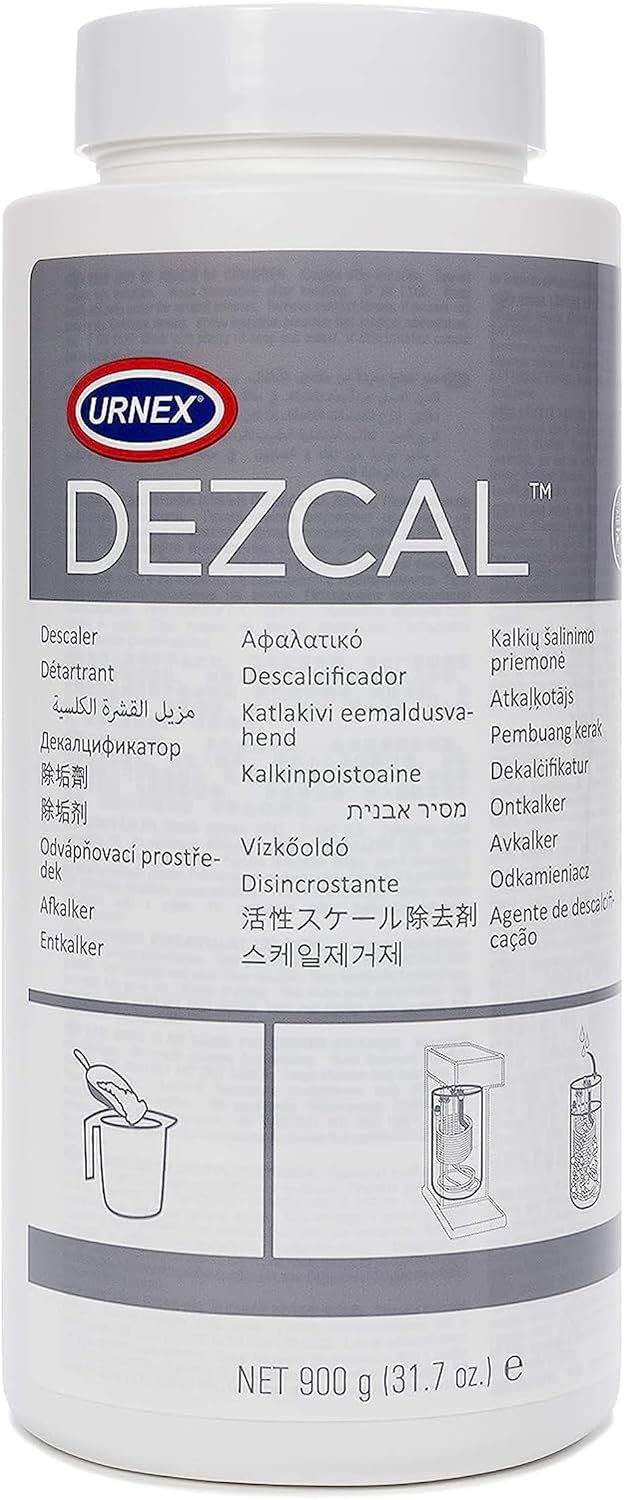 Urnex Dezcal | Safe, measured, made for espresso machines |
| Or the brand-matched option | 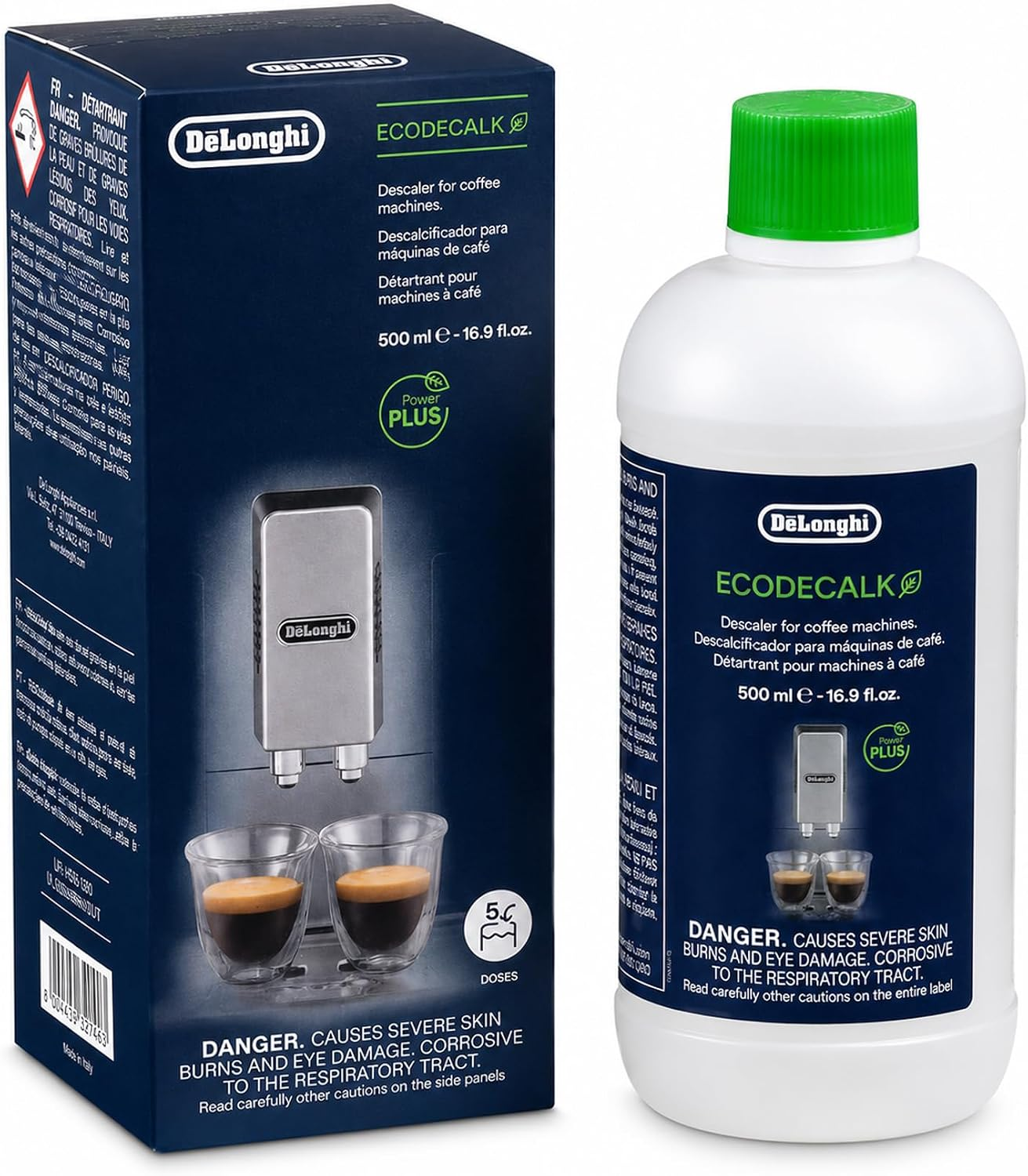 De'Longhi EcoDecalk | Fits De’Longhi’s descale program |
| Run and rinse | A 2 L jug, a cloth, 30 to 50 minutes | Most of the time is rinsing |
Step 1: Find out how hard your water is
How often you descale depends far more on your water than on the calendar. Complete Home Barista lays it out by hardness and use. With soft water (under 75 mg/L) and a shot or two every day, every four to six months is enough. With moderate water (75 to 150 mg/L) and daily use, it is every two to three months. Hard water (150 to 250 mg/L) pushes that to every one to two months, and very hard water to monthly.
Seattle Coffee Gear gives a simpler rule of thumb of every two to three months for daily home use, sooner with hard water. If your machine has a descale light or prompt, that wins. On the Breville Bambino Plus, for example, Breville says the machine wants a descale when the 1-Cup, 2-Cup and Steam buttons flash in turn.
Your water utility’s annual report will list hardness, but a pack of test strips takes ten seconds at the tap and tells you what is actually going into the tank. Many super-automatics also ask you to set the hardness level in the menu so the reminder lands at the right time, and it is worth doing.
Ten seconds at the tap beats guessing. Hardness strips are cheap and sold in big packs; any brand that reads in ppm or mg/L does the job.
Search Hardness Test Strips →Step 2: Choose a descaler (and skip the vinegar)
Every machine maker and retailer we checked says the same thing about vinegar: don’t. De'Longhi says it isn’t recommended for espresso machines, can leave odours and may be too harsh. Seattle Coffee Gear warns that vinegar and generic household descalers can leave residue, damage seals and void warranties. Complete Home Barista adds that it is less effective than citric acid and can be slightly corrosive to rubber seals over time.
That leaves two sensible routes: a descaler made for coffee machines, or plain citric acid if your machine’s maker allows it.
Urnex Dezcal
Dezcal is the descaler Seattle Coffee Gear recommends,. It is a powder, so you mix the amount the label gives into the water tank and adjust for tank size. The 900 g bottle lasts a home machine a long time.
One bottle, years of descaling. The 900 g Dezcal was $29.98 on Amazon when we last checked; check the current price before you buy.
Check Dezcal on Amazon →De’Longhi EcoDecalk
If you own a De’Longhi, use the descaler its program is written around. De’Longhi’s own steps add the descaler up to a marked level in the tank (100 ml of EcoDecalk on the models it describes), then top up with water to a second line. At that dose, the 500 ml bottle covers about five descales. The listing says it can be used on any coffee maker, but De’Longhi owners get the most out of it because the measurements match.
Made for the program on your De’Longhi. The 500 ml bottle was $11.49 on Amazon when we checked.
View EcoDecalk →Citric acid
Complete Home Barista suggests one tablespoon of citric acid per litre of water for stainless steel machines, at a cost of a few dollars a year, followed by two to three clean-water cycles. It also says to avoid it on aluminium parts, where brand tablets are the safer choice. Check your manual first: if the maker specifies its own descaler, using something else can be a warranty question. Food-grade citric acid is easy to find if yours allows it.
Step 3: Run the descale
Machines with a descale mode walk you through it on screen or with flashing lights, and you should follow that sequence rather than any generic guide, including this one. For machines without one, the shape is the same everywhere:
- Empty the tank and the drip tray. Remove any water filter from the tank; descaler and filter cartridges do not mix.
- Mix the solution. Use the amount on the descaler’s label for your tank size.
- Put a big container under the outlets. De’Longhi asks for one that holds at least 2 litres (68 fl oz) and says to allow 30 to 50 minutes.
- Run the solution through. Alternate between the group head and the steam or hot-water wand so both circuits get treated. Seattle Coffee Gear suggests running part of the tank, letting it sit, then running more.
- Let it work. A pause of a few minutes partway through gives the acid time on the scale.
Step 4: Rinse more than you think you need to
This is the step people rush, and it is the one you taste. Seattle Coffee Gear says to rinse the tank and then run two to three full tanks of fresh water through the machine. Programmed machines will ask for one or more rinse cycles on their own; do every one.
Then pull one or two shots and pour them away before you drink anything. If you can still smell or taste the descaler, run another tank.
When not to descale at home
Not every machine should be descaled by its owner. Seattle Coffee Gear notes that Rocket Espresso and some Lelit heat exchanger and dual boiler machines are not designed for home descaling and need professional service, because descaler can get trapped inside and the job can void the warranty. Check the manual for anything with a large boiler or an E61 group before you pour acid into it.
If you are not sure what kind of machine you have, our single boiler vs heat exchanger vs dual boiler explainer will help you work it out.
What you can skip
- Vinegar, for the reasons above.
- Descaling on a fixed calendar if your water is soft. Twice a year can be plenty.
- Backflush detergent for descaling. Detergent removes coffee oil; descaler removes minerals. They are different jobs, and our backflushing and daily cleaning routine covers the oil side.
The cheapest way to descale less often
Seattle Coffee Gear calls a water filter the single best thing you can do to slow scale. A filter pitcher, the cartridge that came with your machine, or an in-tank filter will all stretch the time between descales. Change the cartridge when the maker says to, because a spent one stops doing much.
If the budget is tight, buy the test strips first. They tell you whether you need to descale monthly or twice a year, and that decides how much descaler you will actually go through. If your machine is new, our guide to what matters in a first espresso machine has more on living with one.