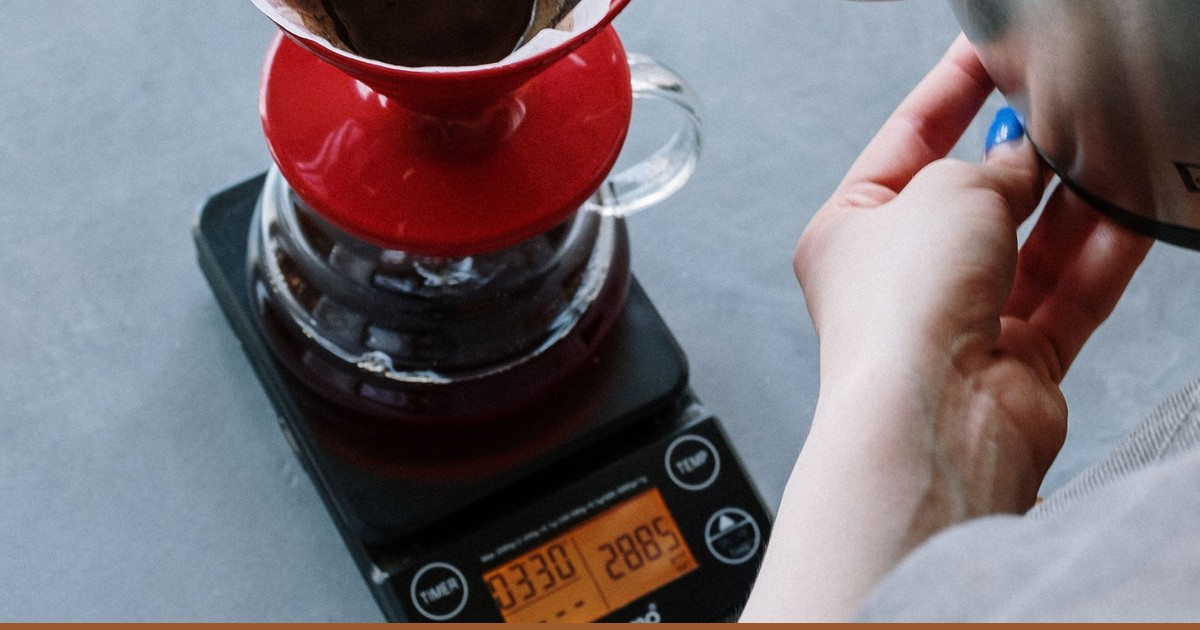
Coffee Scales: Why Grams Beat Scoops
Monday’s coffee was great. Tuesday’s, made the same way with the same beans, was thin and sour. Wednesday’s was bitter. You did not change anything, or at least you think you did not.
Nine times out of ten, the thing that changed is the amount of coffee. A scoop is a measure of volume, and coffee is sold, roasted and extracted by weight. A cheap kitchen-sized coffee scale fixes that, and it is the single most useful thing you can add to a home setup for the money.
Disclosure: Espresso at Home is reader-supported. As an Amazon Associate we earn from qualifying purchases, at no extra cost to you.
Why a scoop lies to you
A level scoop looks the same every morning. What is inside it is not. Seattle Coffee Gear points out that, depending on roast level and grind size, a scoop can hold anywhere from 6 to 10 grams of coffee. That is a swing of more than 60% from the same spoon.
Dark roasts are puffier and lighter for their size than light roasts. Whole beans pack differently from ground coffee. A heaped scoop and a level scoop are two different recipes. None of that shows up when you measure by eye.
Ratios only work in grams
Every good brew recipe is a ratio of coffee to water. The Specialty Coffee Association’s Gold Cup guideline, as Seattle Coffee Gear summarises it, is 55 grams of coffee per litre of water, roughly 1:18. Plenty of people prefer a stronger 1:15 or 1:16 for pour-over. Espresso is usually written as a dose in and a weight out, for example 18 g of coffee giving about 36 g of espresso.
All of those numbers are weights. You can follow them with a scale on day one. You cannot follow them with a scoop and a measuring jug, because the scoop is guessing the coffee and the jug is guessing the water.
What a scale changes in practice
- You can repeat a good cup. Write down the dose, water and grind setting that worked. Do it again tomorrow.
- You can fix a bad cup. Sour? Grind finer or use a bit more coffee. Bitter? The opposite. With weights, you change one thing at a time and know what you changed.
- You stop wasting beans. Over-scooping by a couple of grams a cup adds up across a bag.
- New beans are easier to dial in. Keep the ratio fixed and only adjust the grind.
What to look for in a coffee scale
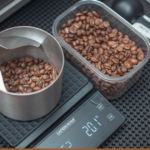
A kitchen scale that reads in whole grams is better than a scoop, but coffee scales add three useful things.
- 0.1 g resolution. It matters most for espresso, where half a gram changes the shot.
- A built-in timer. Pour-over and espresso are both timed, and having weight and time on one screen means you are not juggling a phone.
- A size that fits your brewer. It should hold a carafe and dripper for pour-over, or fit under the portafilter on your espresso machine.
Things that matter less: app connectivity, which most people stop using after a week, and very high capacity, since you rarely weigh more than a kilo of coffee and water at once.
Three scales for three kinds of coffee maker
For anyone starting out: Greater Goods Coffee Scale with Timer
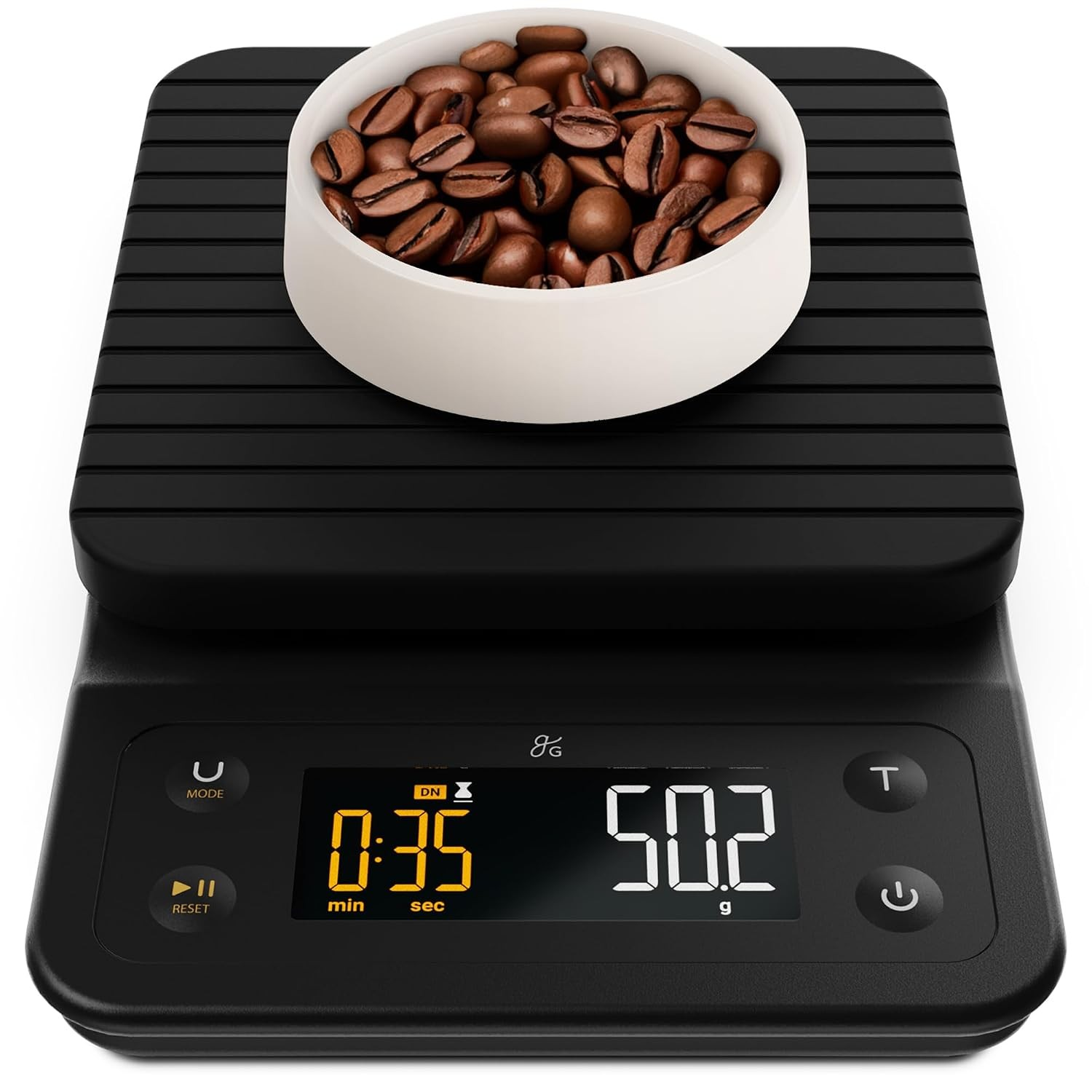
If you just want to stop scooping, start here. Greater Goods lists a 0.1 g sensor, a count-up and count-down timer, and a 5.25 x 5.25 inch weighing surface under a removable silicone cover that is heat-resistant and dishwasher-safe.
The dual-colour display keeps weight and time apart, which is handy when you are pouring a kettle with one hand. For drip coffee, French press or a first pour-over setup, it does everything you need.
Ready to ditch the scoop? It was $29.99 on Amazon when we checked.
See the Greater Goods Scale →For pour-over: Hario V60 Drip Scale
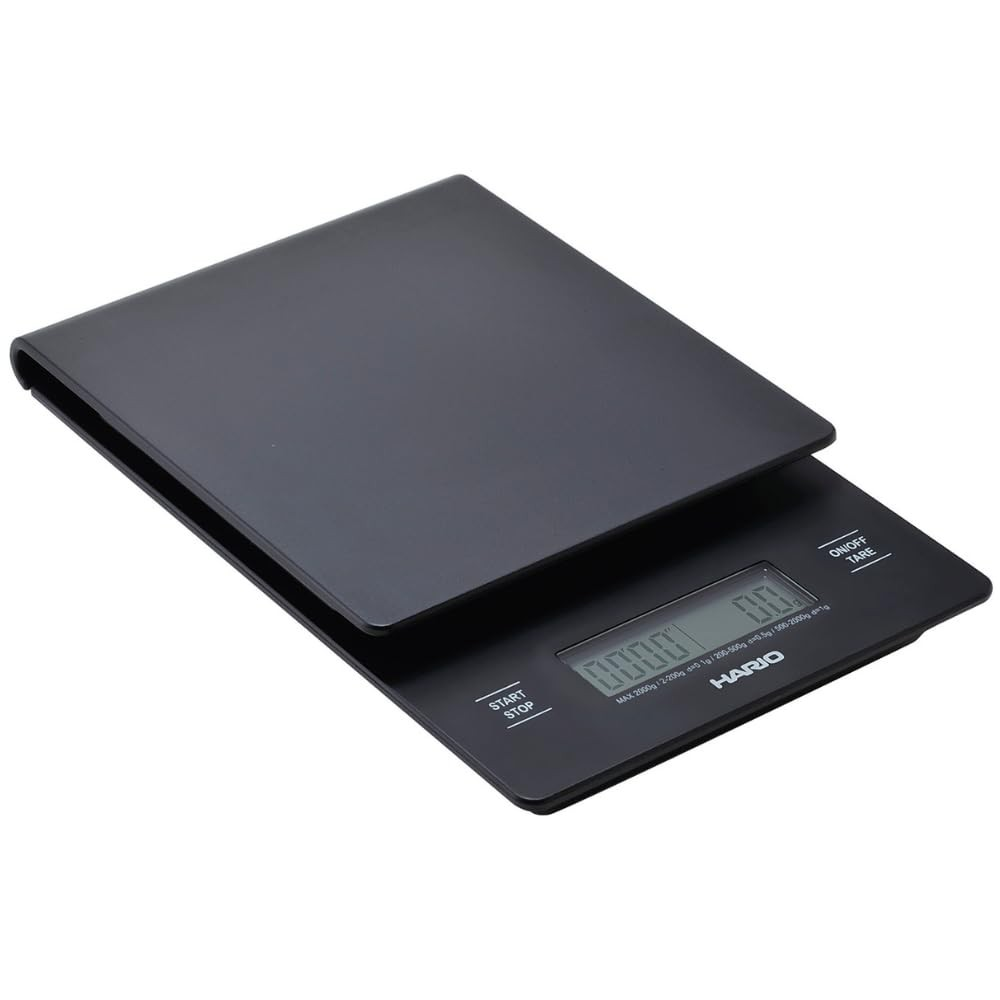
Hario designed this one around its own V60 dripper and server. It reads in 0.1 g steps, has a built-in timer, and is slim, at 120 x 190 x 29 mm according to the listing, with a 2,000 g maximum. It runs on two AAA batteries.
The newer model also has faster start-up, anti-slip feet and better water resistance than the original. If pour-over is your main brew, the long, narrow shape sits nicely under a dripper and server with room to see the display.
Brewing V60 most mornings? The Hario scale was $44.95 on Amazon when we checked.
Check the Hario Drip Scale →For espresso and everything else: Timemore Black Mirror Basic 2
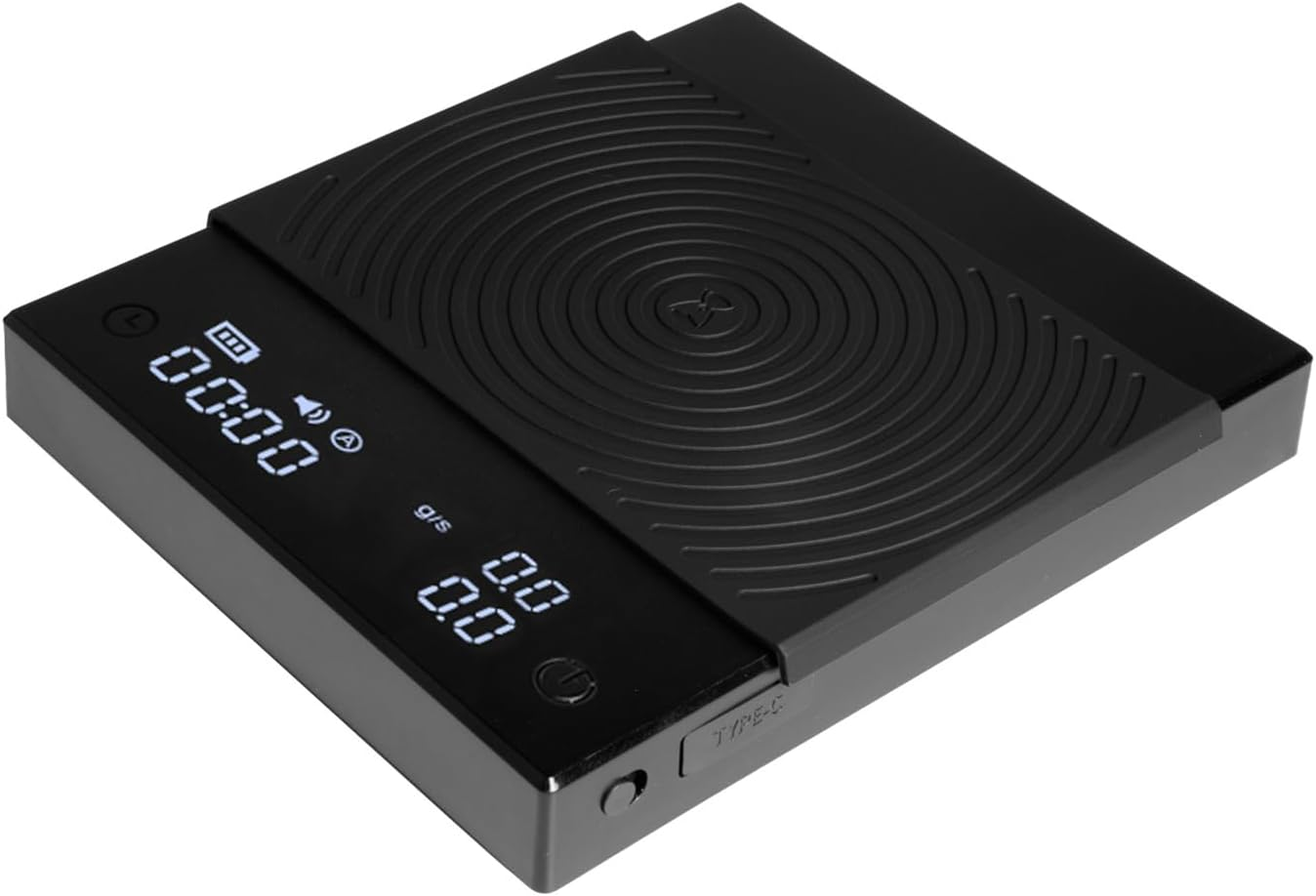
The Timemore Basic 2 is the one we recommend in our espresso accessories guide. It measures in 0.1 g steps, has a timer, and adds a flow-rate readout that shows how fast you are pouring, which is genuinely helpful when you are learning pour-over.
At about 15 x 13 cm it is small enough to sit on most espresso drip trays, so you can weigh the shot as it runs. That is the habit that improves espresso fastest: weigh the dose, weigh the shot, time it.
One scale for espresso and filter? It was $44 on Amazon when we checked.
See the Timemore Basic 2 →| Scale | Resolution | Timer | Best for | Amazon | |
|---|---|---|---|---|---|
| Greater Goods Coffee Scale | 0.1 g | Yes | First scale, drip and French press | Check Price |
| Hario V60 Drip Scale | 0.1 g | Yes | Pour-over | Check Price |
| Timemore Basic 2 | 0.1 g | Yes, plus flow rate | Espresso and pour-over | Check Price |
A simple routine to start with
You do not need to become a coffee scientist. Try this for a week:
- Put your mug, carafe or portafilter on the scale and press tare.
- Weigh your beans before grinding. For a 350 ml mug of filter coffee, start around 20 g (roughly 1:17).
- Grind, put the grounds in the brewer, and tare again.
- Pour water until the scale reads 350 g. A gram of water is a millilitre, so this replaces the measuring jug.
- Taste. Too weak? Next time try 21 g. Too strong? Try 19 g. Change one thing at a time.
For espresso, the same idea works with smaller numbers: weigh the dose into the basket, then weigh the shot in the cup.
Small habits that make the scale worth it
- Tare before every step. Forgetting to zero the scale after adding the dripper is the most common reason a recipe “stops working”.
- Keep it dry. Wipe up spills straight away, even on water-resistant models, and do not leave a wet kettle base on it.
- Swap the batteries before they die. A weak battery can make readings drift, and you will not notice until the coffee tastes off.
- Write the recipe down. A note on the fridge or in your phone with dose, water, grind and time is what turns one good cup into a good week.
The short version
A scoop measures space, not coffee, and the amount in it changes with every bag. A scale costs less than a few café drinks, makes good cups repeatable and bad cups fixable, and takes ten seconds a morning. If you are building a setup from scratch, our pour-over beginners’ gear guide shows where it fits alongside the kettle and grinder.
A scale is the first tool to reach for when shots go wrong. See how it fits into our guide to fixing sour or bitter espresso.
A scale also makes one of the best presents for a coffee friend; see our coffee gifts for every budget.
A scale also makes freezing beans easier. See our guide to storing coffee beans: freezer, canister or bag.
Weighing also settles the roast debate: see light vs dark roast caffeine and flavor myths.
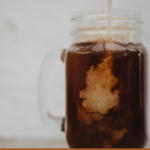
Weighing matters even more for cold brew at home, where a 1:4 and a 1:12 recipe look alike in a scoop.