Your First Espresso Machine: What Actually Matters
Shopping for a first espresso machine is confusing on purpose. Every box shouts a bar number, every listing has a feature list as long as your arm, and the prices run from under $100 to the cost of a used car.
Most of that noise does not decide whether you will be making good coffee in a month. A handful of things do. Here is what to look for, what to ignore, and three machines that fit the most common kinds of first-time buyer.
Disclosure: Espresso at Home is reader-supported. As an Amazon Associate we earn from qualifying purchases, at no extra cost to you.
Ignore the bar number on the box
Espresso extracts best at around 9 bar. When a box says 15 or 20 bar, that is the pump’s maximum, not the pressure at the coffee. CoffeeGeek explains that typical pumps are built to put out 15 to 18 bar at most, with valves that bring brew pressure down to around 9. Clive Coffee says the same and calls the big numbers marketing.
So a “20 bar” machine is not better than a “15 bar” one. If you want to compare machines on pressure at all, look for a pressure gauge or a mention of 9 bar extraction.
What actually matters
Stable brew temperature (PID)
A PID controller holds the water at a set temperature instead of letting the heater swing on and off around it. Clive calls it non-negotiable. CoffeeGeek points out it now shows up on machines from around $350, and suggests a simple test for whether a machine really has it: can you change the brew temperature?
A real, non-pressurized basket
Many entry machines ship with pressurized (dual-wall) baskets that make a foamy shot from almost any coffee. They are forgiving, but they hide what is going on. Clive’s advice for a first machine is a standard, non-pressurized basket, because a pressurized one keeps changing the rules on you. A good compromise is a machine that comes with both, so you can start easy and move up once you have a proper grinder.
How many milk drinks you make
This decides the type of machine more than anything else. One latte a day and almost any design works. Several in a row and you will hate waiting for a small single boiler to switch between brewing and steaming. Our explainer on single boiler, heat exchanger and dual boiler machines goes into the details. For most first machines, the honest answer is a fast-heating single boiler or thermojet.
A grinder budget
This is the one people skip. Clive suggests putting at least a third of the total budget into the grinder, and in its skill-level guide says 30 to 40%. CoffeeGeek puts it bluntly: a $200 machine with a $500 grinder beats the reverse. If the budget is $500 in total, a $300 machine and a $200 grinder will give you better espresso than a $500 machine and a blade grinder. More on that in why your grinder matters more than your machine.
Your counter and your mornings
Measure the space under your cabinets, then check where the water tank fills. Clive suggests asking a plain question: can you refill the reservoir easily, or do you have to drag the machine out every time? Warm-up time matters too. A machine that takes 20 minutes to heat is a machine you stop using on weekdays.
Portafilter size, a little
58 mm is the commercial standard, and CoffeeGeek’s rule of thumb is “53mm ok, 57mm better, 58mm best!” A 58 mm machine opens up the widest choice of baskets, tampers and bottomless portafilters. But plenty of great first machines use 54 mm, and the size matters far less than the basket and the grinder.
What does not matter much
- The bar number. See above.
- Case material. Seattle Coffee Gear says not to worry much about it on a first machine, because “It’s the inside that really matters.”
- Looks and hype. Clive lists the look, the brand and the YouTube buzz as secondary.
- Smart features. Automatic steaming and app control are nice. Seattle Coffee Gear calls smart steaming “not a necessity.”
A quick checklist before you buy
- Does it brew at around 9 bar, regardless of the pump rating?
- Does it have PID or another stable temperature system?
- Does it come with a non-pressurized basket?
- How many milk drinks will you make in a row, and can it keep up?
- Have you set aside a third or more of the budget for a grinder?
- Will it fit under your cabinets, and can you refill the tank in place?
Three good first machines, by type of buyer
Mostly espresso and Americanos: Breville Bambino
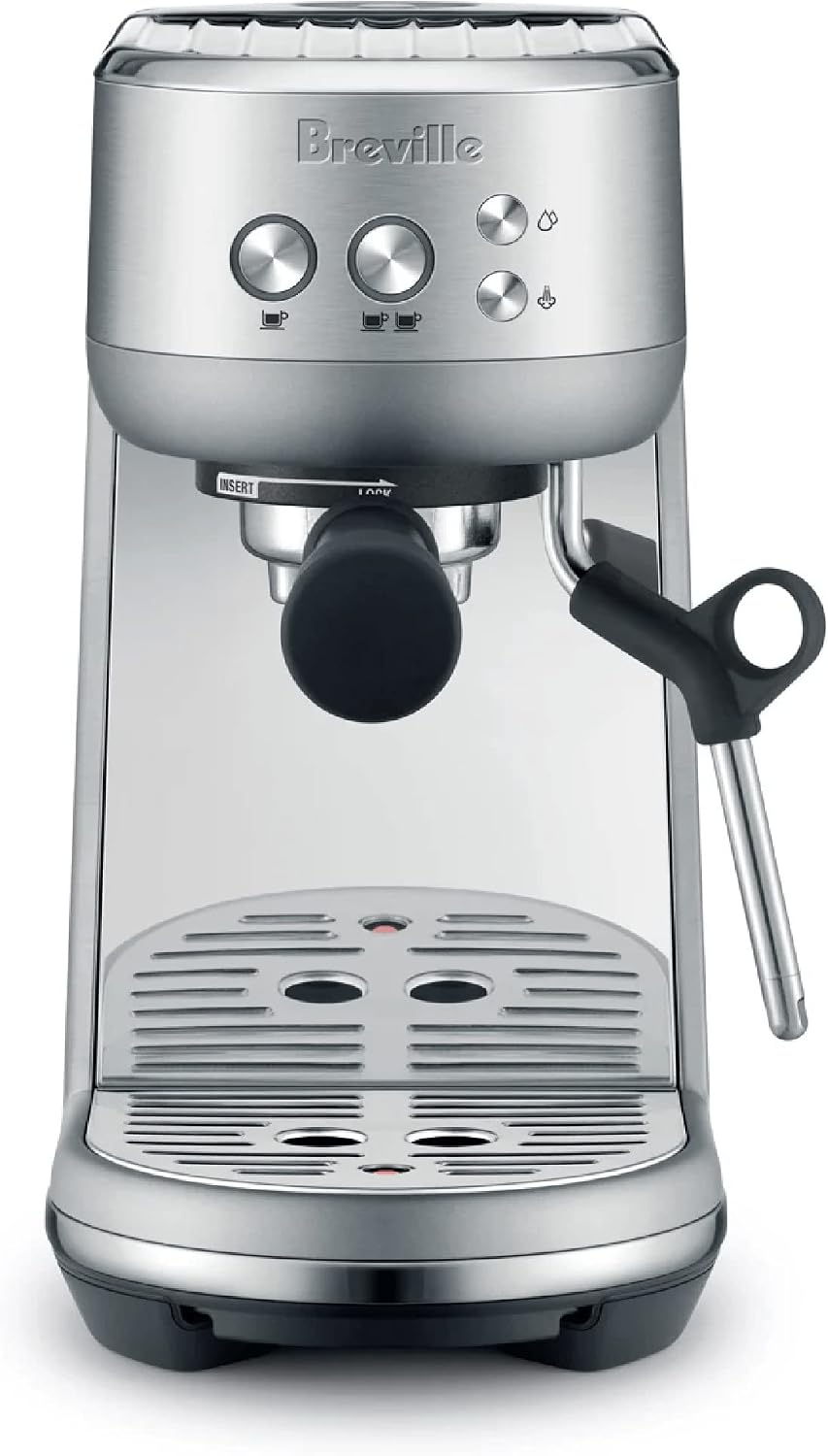
The plain Bambino shares its brewing hardware with the Bambino Plus: the ThermoJet heater that is ready in about three seconds, PID temperature control, low-pressure pre-infusion before 9 bar extraction, and a 54 mm portafilter built around an 18 g dose.
The difference is milk. The Bambino has a manual steam wand only. If you mostly drink straight espresso or Americanos, or you want to learn to steam by hand, that is no loss, and Breville lists it at $299.95, which leaves room for a real grinder. Our Bambino Plus review compares the two in detail.
The cheapest way into real espresso with a proper grinder. Same brewing hardware as the Plus, $200 less at list price.
Check the Bambino on Amazon →Milk drinks every morning: Breville Bambino Plus
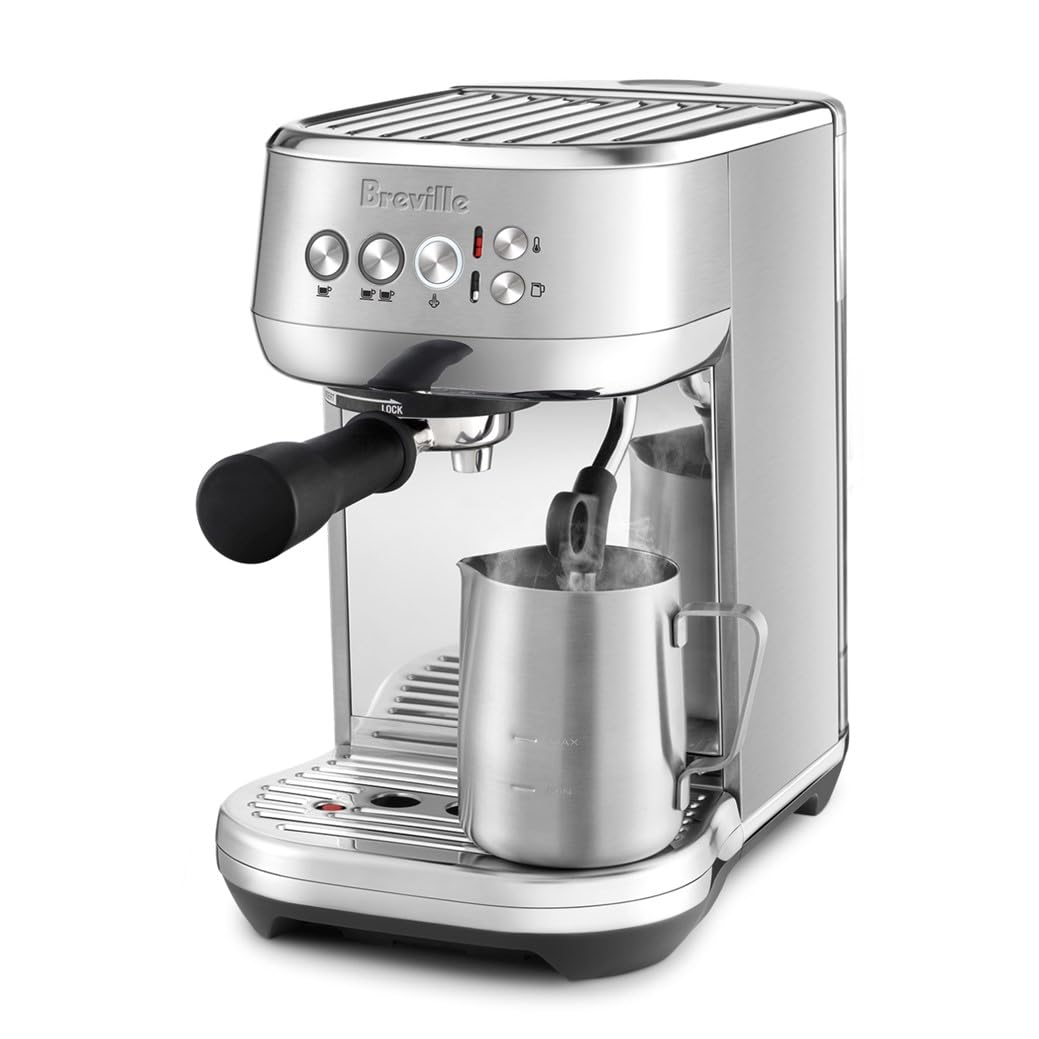
If lattes and flat whites are the point, the Plus is the easier machine to live with. Its automatic wand textures milk in the included 16 oz jug at one of three temperatures and three texture levels, then switches itself off. You can still steam manually later.
It is small, ready in seconds, and good for one or two milk drinks at a time. It cannot brew and steam together, and its 64 fl oz tank and shallow drip tray need regular attention in a busy house. Breville lists it at $499.95.
Good milk from week one. Amazon prices on the Plus move around a lot, so check today’s.
See the Bambino Plus Price →Wants to learn the craft: Gaggia Classic E24
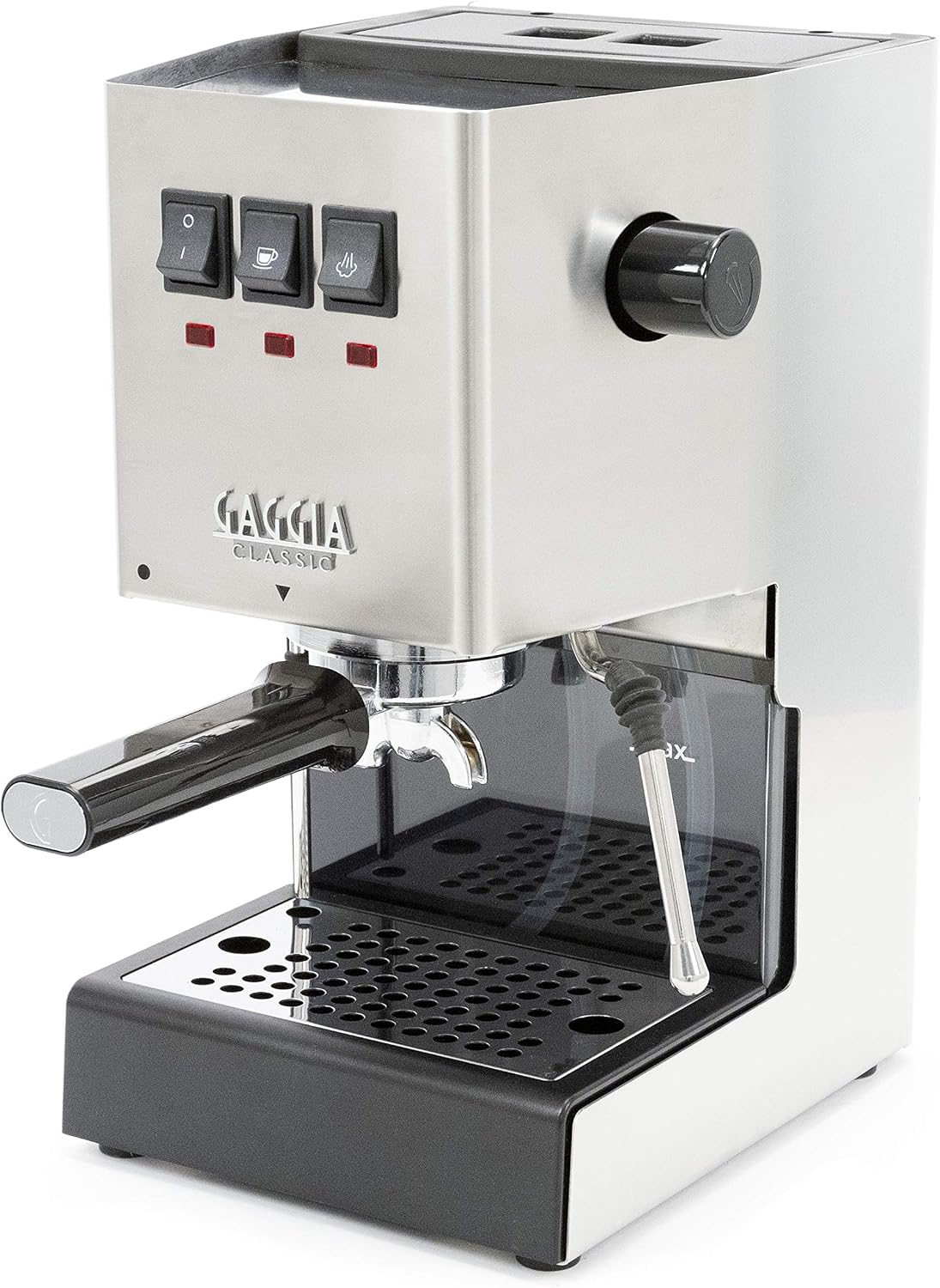
The Gaggia Classic is the traditional single boiler that many home baristas start on. The E24 version, per Whole Latte Love’s listing, has a brass boiler rated at 1,350 W, a 58 mm stainless portafilter, a pressure valve set for 9 bar extractions and a commercial-style three-way solenoid that dries the puck after each shot. The tank holds 72 fl oz.
It asks more of you than a Breville. You will wait for the boiler to switch between brew and steam, and you will learn by doing. In return you get 58 mm accessories and a simple machine that is cheap to keep running. When we last checked it was about $450 on Amazon.
For people who want to understand every shot. A simple, repairable machine with full-size 58 mm parts.
View the Gaggia Classic E24 →Never going to touch a grinder? Consider a bean-to-cup instead
If nobody in the house will ever weigh a dose, a super-automatic like the Philips 3200 LatteGo may be the better first machine. It grinds, brews and froths at the press of a button, and its two-part milk system rinses clean without tubes. It costs more upfront and you trade control for convenience. Our alternatives to a Nespresso guide covers it in more detail.
All the convenience, fresh beans every cup. Check the current price on Amazon.
Check the Philips 3200 →And the grinder to go with it
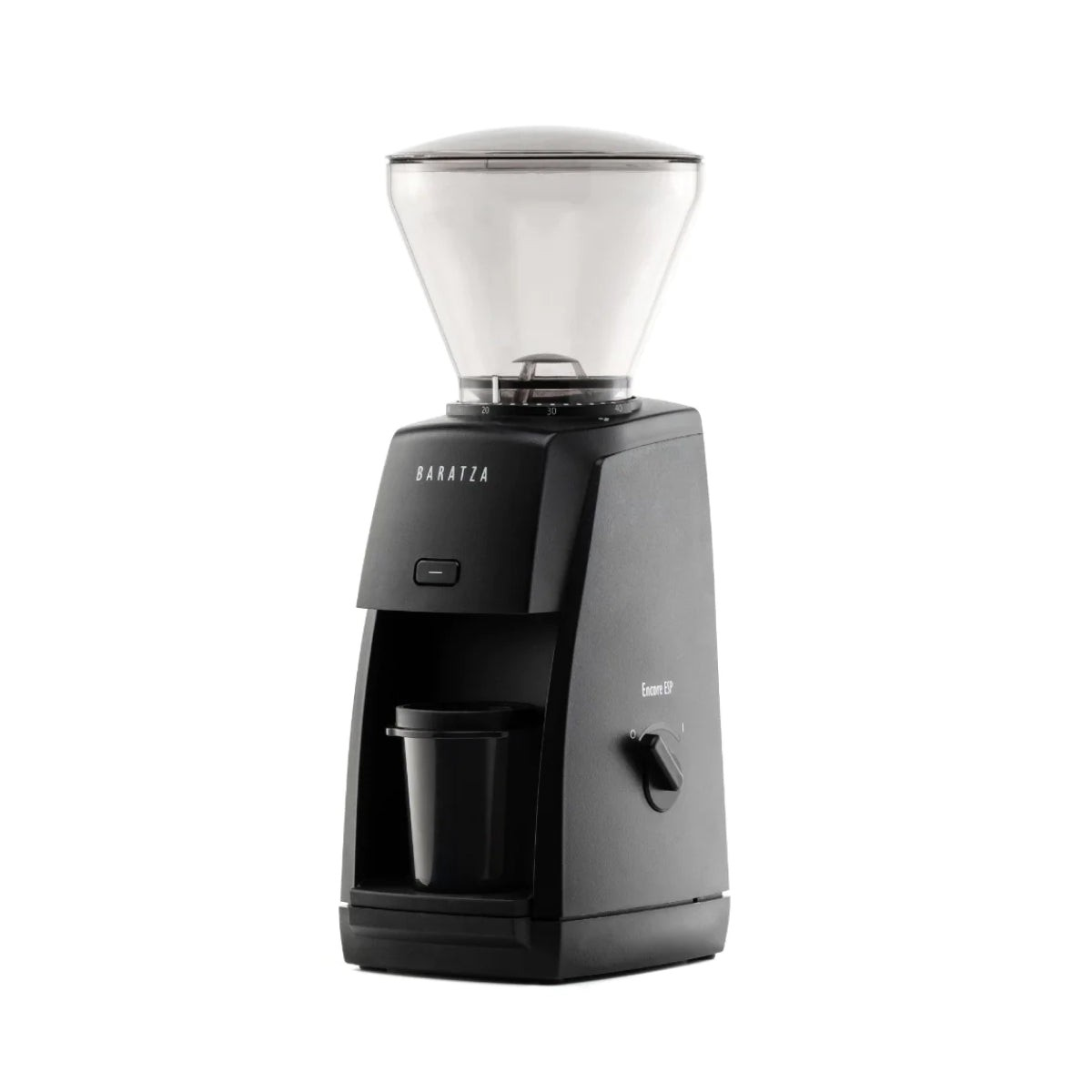
For any of the three machines above, the Baratza Encore ESP is the grinder we would start with. Settings 1 to 20 are the espresso range, its dosing cup fits 54 mm portafilters with an adapter for 58 mm, and it lists at $199.95. We could not find it sold directly on Amazon, so the link is a search. If you own a Breville and drink mostly milk drinks, the Breville Smart Grinder Pro is the other natural partner.
Half the dial is spent on espresso. Search for current sellers, and make sure the listing says ESP.
Search the Encore ESP →Once the box arrives, our espresso accessories guide covers the few extras worth buying in the first month, and the sour or bitter troubleshooting guide will save you a frustrating first week.
Before you buy, read the espresso machine myths beginners believe, from 20 bar pumps to thick crema.